
Retargeting Funnel Setup: Turn Visitors Into Customers With Staged Remarketing

You’re running retargeting ads. Everyone who visits your site sees the same ad for 30 days. Some click, most don’t, and your frequency cap is the only thing standing between you and ad fatigue. Sound familiar? That’s not a retargeting strategy — it’s a spray-and-pray approach that wastes budget and annoys potential customers.
A proper retargeting funnel treats different visitors differently based on how far they progressed toward conversion. Someone who browsed your homepage for 10 seconds gets different messaging than someone who spent 20 minutes on your pricing page. The result: higher click-through rates, lower cost per acquisition, and a better user experience.
In this guide, I’ll show you how to build a multi-stage retargeting funnel from scratch — the audience segments, the messaging strategy for each stage, and the technical setup in Google Ads and Meta. This is the system I use for clients, and it consistently outperforms single-audience retargeting by 2-4x.
Why single-audience retargeting fails
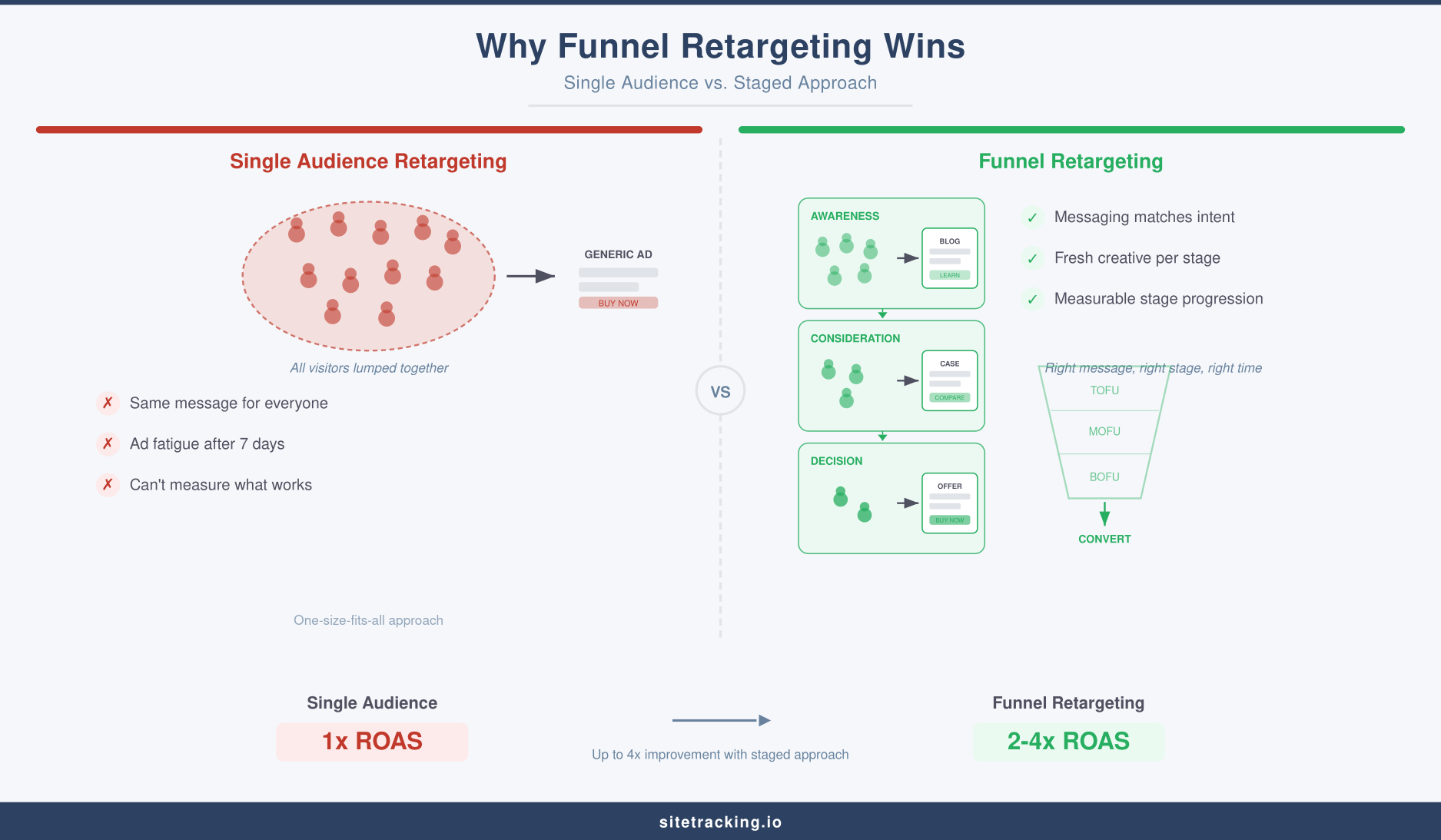
Most retargeting campaigns use one audience: “all website visitors in the last 30 days.” This approach has three fundamental problems.
First, it treats cold browsers the same as hot prospects. Someone who bounced after 5 seconds has entirely different intent than someone who added a product to their cart. Showing them the same ad wastes impressions on the low-intent group and under-serves the high-intent group.
Second, it burns out your audience. When the same ad follows someone for 30 days regardless of their actions, ad fatigue sets in fast. Click-through rates drop, frequency costs rise, and your brand starts feeling intrusive rather than helpful.
Third, it can’t measure what’s actually working. With one audience, you can’t tell if your retargeting success comes from recovering cart abandoners (who would likely return anyway) or from re-engaging casual browsers (which is harder but more valuable). Without segmentation, you’re optimizing blind.
The three stages of a retargeting funnel
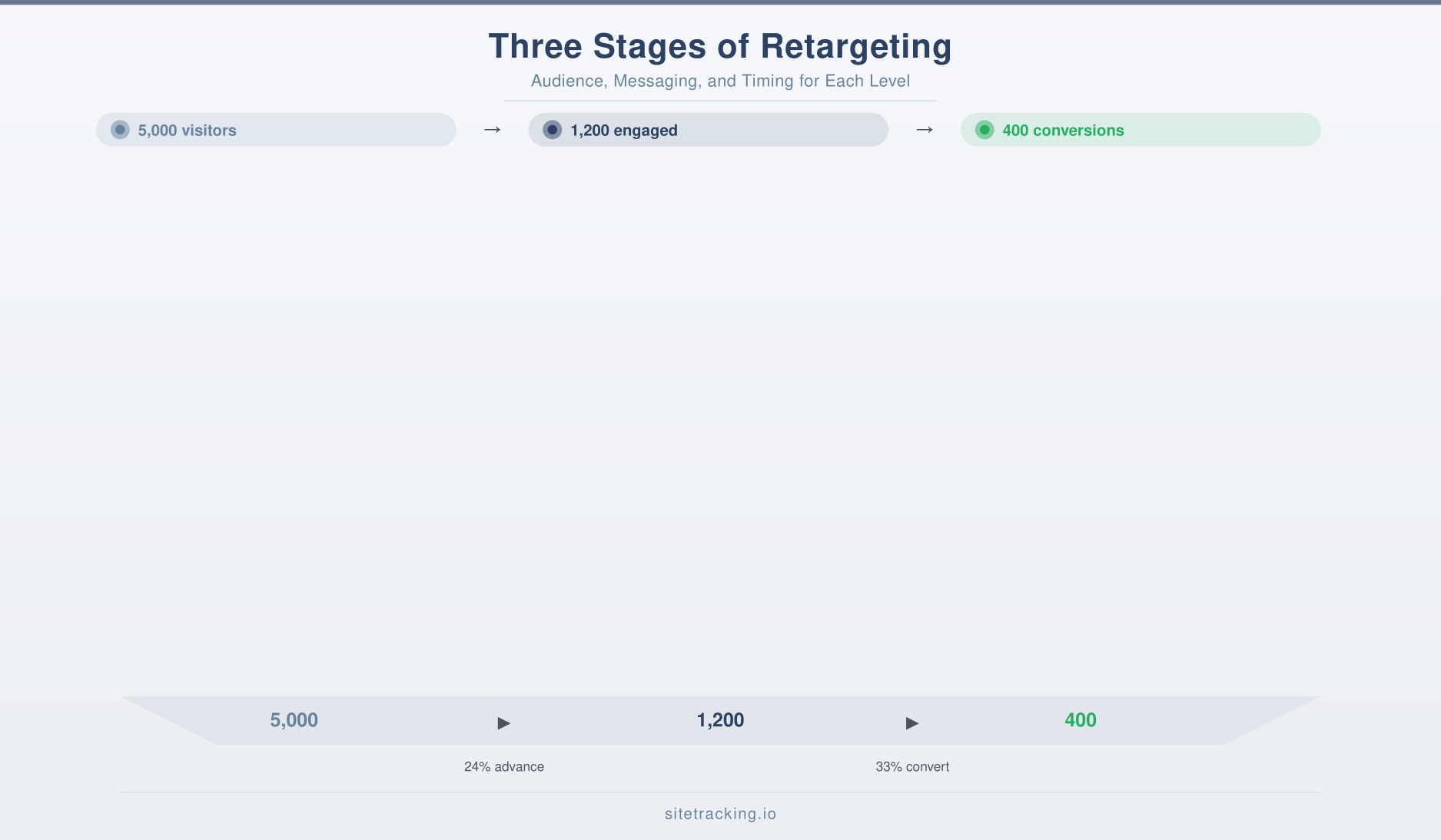
A well-built retargeting funnel has three distinct stages. Each targets a different level of intent and uses different messaging to move users toward conversion.
Stage 1: Awareness retargeting (low intent)
Audience: Users who visited your site but didn’t engage deeply — typically less than 30 seconds on site or viewed only 1 page. These users know you exist but haven’t shown buying intent.
Messaging: Educational content that builds trust. Share blog posts, guides, case studies, or videos that address their likely pain points. Don’t sell yet — earn their attention. The goal is to bring them back for a deeper visit.
Window: 3-7 days after visit. After 7 days, these low-intent visitors have likely forgotten about you, and continued retargeting has diminishing returns.
Stage 2: Consideration retargeting (medium intent)
Audience: Users who engaged meaningfully — viewed multiple pages, spent time on product/service pages, or consumed content like blog posts or videos. These are your micro-conversion completers who showed research behavior.
Messaging: Product-focused content that addresses specific objections. Feature comparisons, testimonials, demos, free trials, or webinar invitations. Highlight your differentiators and social proof. The goal is to move them from “interested” to “ready to buy.”
Window: 7-14 days. Medium-intent users are actively evaluating options, so a longer window makes sense. But adjust based on your typical sales cycle — B2B SaaS might extend to 30 days, while e-commerce should stay shorter.
Stage 3: Conversion retargeting (high intent)
Audience: Users who showed strong purchase intent — viewed pricing, added to cart, started checkout, or began a form without completing it. These people were ready to convert but something stopped them. This is also where your form abandonment data becomes directly actionable.
Messaging: Direct conversion messaging. Limited-time offers, urgency triggers, specific objection handling, and strong CTAs. “Complete your purchase — 10% off for the next 24 hours.” The goal is to remove the final barrier to conversion.
Window: 1-7 days. High-intent users convert quickly or move on. A short, aggressive window prevents wasted spend. After 7 days, move them back to the consideration stage.
How to build your audience segments
The foundation of a retargeting funnel is precise audience segmentation. Here’s how to set up each segment using GA4 audiences that sync to your ad platforms.
Setting up GA4 audiences
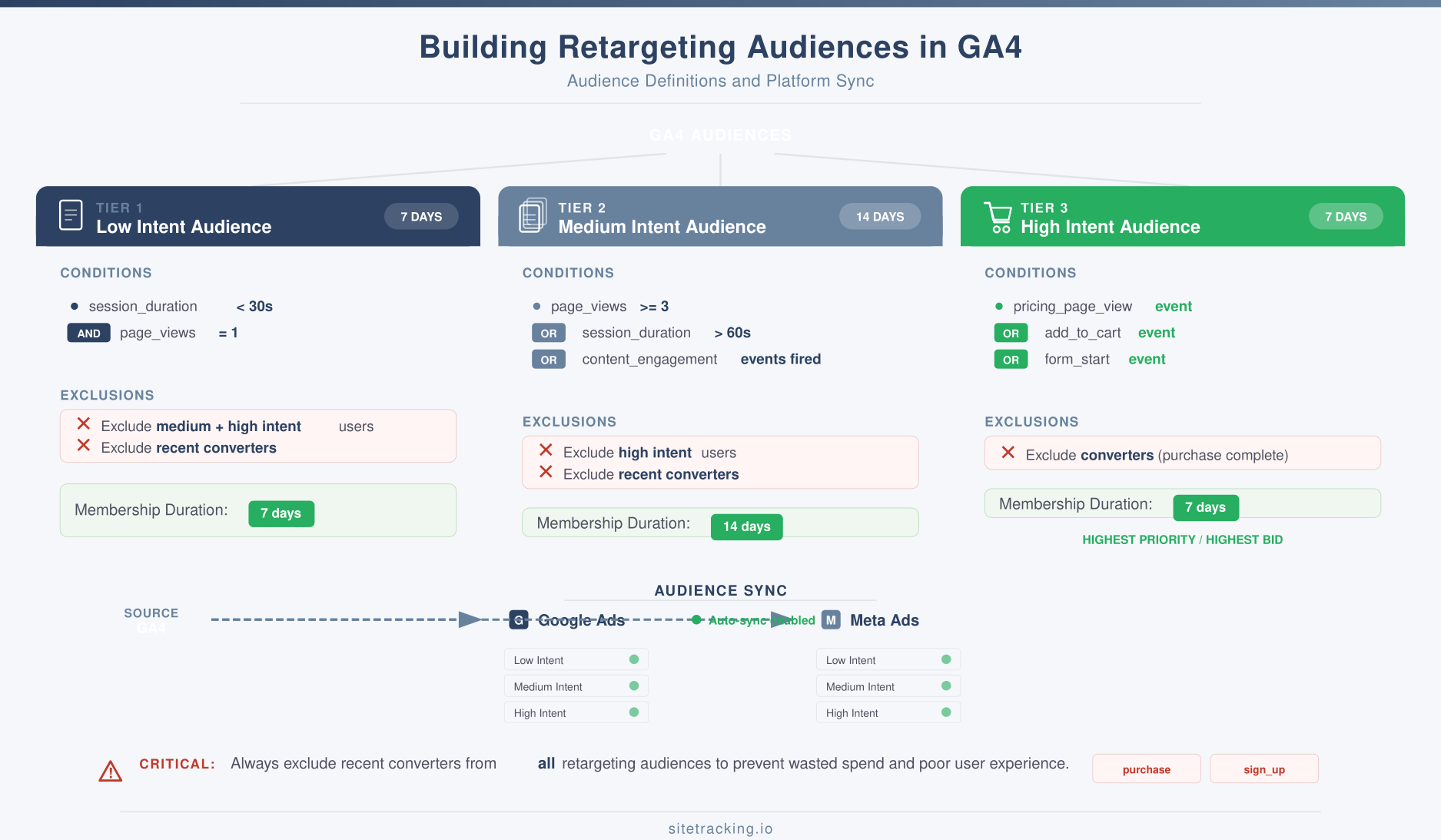
In GA4, go to Admin → Audiences → New Audience. Create these three segments using event conditions and parameters. Make sure your event naming is consistent so your audience definitions work reliably.
- Low Intent (Stage 1): Session duration under 30 seconds AND page views = 1. Exclude users who match medium or high intent criteria. Membership duration: 7 days.
- Medium Intent (Stage 2): Page views >= 3 OR session duration > 60 seconds OR specific content engagement events (video_start, scroll_depth_75, resource_download). Exclude high-intent users. Membership duration: 14 days.
- High Intent (Stage 3): Pricing page view OR add_to_cart OR form_start OR checkout_begin. Exclude users who completed a conversion event. Membership duration: 7 days.
Critical: Always exclude existing customers and recent converters from all retargeting audiences. Nothing wastes budget faster than retargeting someone who already bought. Use a “Purchasers” exclusion audience with a 30-60 day membership duration.
Platform-specific setup
GA4 audiences automatically sync to Google Ads if your accounts are linked. For Meta (Facebook/Instagram), you’ll need to use the Meta Pixel and create Custom Audiences with similar logic in Events Manager. The principles are identical — only the interface differs.
Use UTM parameters on all retargeting ad URLs so you can track which funnel stage drives conversions in your analytics. Tag each stage distinctly: utm_campaign=retargeting_stage1, utm_campaign=retargeting_stage2, etc.
Creative strategy for each funnel stage
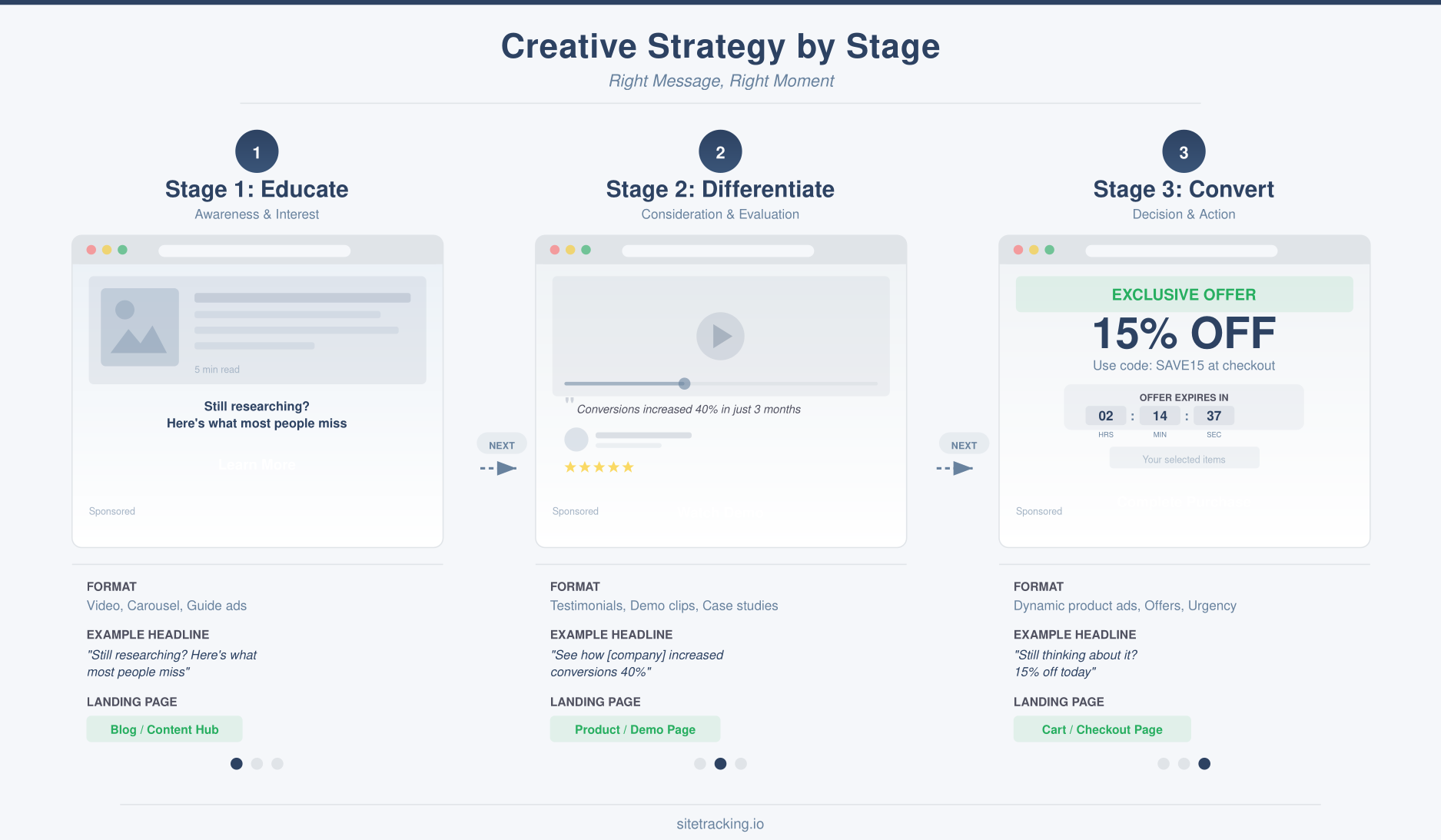
The right message at the wrong stage is just noise. Here’s what works at each level.
Stage 1 creative: educate and build trust
- Ad format: Video ads, carousel ads linking to blog posts, or image ads promoting downloadable guides.
- Headline examples: “Still researching [topic]? Here’s what most people miss.” / “The 5-minute guide to [their problem].”
- CTA: “Learn More” or “Read the Guide” — low commitment, high value.
- Landing page: Blog post or content hub — not a product page or pricing page.
Stage 2 creative: differentiate and persuade
- Ad format: Testimonial videos, product demo clips, comparison graphics, or case study highlights.
- Headline examples: “See how [company] increased conversions 40% with [product].” / “Why 500+ teams chose [product] over [competitor].”
- CTA: “Watch Demo,” “Start Free Trial,” or “See Pricing.”
- Landing page: Product page, demo page, or dedicated comparison page.
Stage 3 creative: convert with urgency
- Ad format: Dynamic product ads (showing the exact items they viewed), countdown timers, or simple image ads with strong offers.
- Headline examples: “Still thinking about it? Here’s 15% off.” / “Your cart is waiting — free shipping ends tonight.”
- CTA: “Complete Purchase,” “Claim Your Offer,” or “Get Started Now.”
- Landing page: Cart page, checkout page, or a dedicated offer landing page with conversion tracking in place.
Measuring retargeting funnel performance
Track each funnel stage as a separate campaign so you can measure performance independently. Key metrics to watch:
- Stage progression rate. What percentage of Stage 1 users eventually appear in Stage 2? And Stage 2 to Stage 3? Low progression rates mean your messaging isn’t compelling enough at that stage.
- Cost per stage conversion. Track the cost to move a user from one stage to the next. Stage 1 should be cheapest (awareness actions cost less), Stage 3 most expensive per action but most valuable.
- ROAS by stage. Measure return on ad spend for each stage independently. Stage 3 will show the highest direct ROAS, but Stages 1 and 2 contribute to the pipeline that feeds Stage 3.
- Frequency and fatigue. Monitor ad frequency (average impressions per user) at each stage. When CTR drops and frequency exceeds 5-7 at any stage, rotate creative or tighten the audience window.
- Assisted conversions. Use your attribution model to credit Stages 1 and 2 for conversions that happen at Stage 3. Multi-touch attribution shows the true value of your full funnel.
Frequently Asked Questions
How much budget should each stage get?
Start with a 20/30/50 split: 20% for Stage 1 (awareness), 30% for Stage 2 (consideration), 50% for Stage 3 (conversion). Adjust based on performance data after 2-4 weeks. If your pipeline is thin, shift more to Stages 1 and 2 to build it up.
What if my audience is too small for segmentation?
If your total monthly visitors are under 5,000, three-stage segmentation may create audiences too small for effective delivery. Start with two stages instead: “engaged visitors” (medium + high intent combined) and “all other visitors.” As your traffic grows, split into three stages.
Should I use the same retargeting funnel on Google and Meta?
The funnel structure should be the same, but creative formats will differ. Google Display and YouTube work well for awareness (Stage 1), while Meta’s targeting and visual formats excel at all three stages. Run both platforms with the same funnel logic and compare performance to optimize budget allocation.
Key takeaways
- Single-audience retargeting wastes budget by treating all visitors the same. Segment by intent level for 2-4x better performance.
- Three funnel stages — awareness (low intent), consideration (medium intent), and conversion (high intent) — each need different messaging and windows.
- Build audiences in GA4 using event conditions and sync them to Google Ads and Meta for targeting.
- Match creative to intent — educate at Stage 1, differentiate at Stage 2, convert with urgency at Stage 3.
- Always exclude recent converters to prevent wasting budget on people who already bought.
- Measure each stage independently and use multi-touch attribution to understand the full funnel’s contribution to revenue.
A retargeting funnel isn’t complicated to build, but it requires discipline to maintain. Set up the three audience segments, create stage-appropriate creative, and track performance at each level. The payoff is immediate: lower costs, higher conversion rates, and a user experience that builds trust instead of eroding it. Start with your highest-traffic pages, build the segments, and let the funnel do the work.