
Marketing Measurement Maturity Model: Assess Where You Are and Build What’s Next

Here’s a question most marketing teams can’t answer honestly: how mature is your measurement practice? Not “do you have Google Analytics installed” — that’s table stakes. I mean: can you connect a marketing campaign to actual revenue? Can you tell your CFO which channels deserve more budget and which are wasting money? Can you run a test and trust the results?
Most organizations land somewhere between “we track pageviews” and “we have dashboards nobody trusts.” The gap between that and data-driven decision making isn’t tools or technology — it’s maturity. A marketing measurement maturity model gives you a framework to assess where you are, understand what’s missing, and build a roadmap to get where you need to be.
In this guide, I’ll walk you through the five levels of measurement maturity, the capabilities that define each level, and the specific actions to move from one level to the next. Whether you’re just getting started or trying to level up an already-sophisticated practice, this framework will show you exactly where to focus.
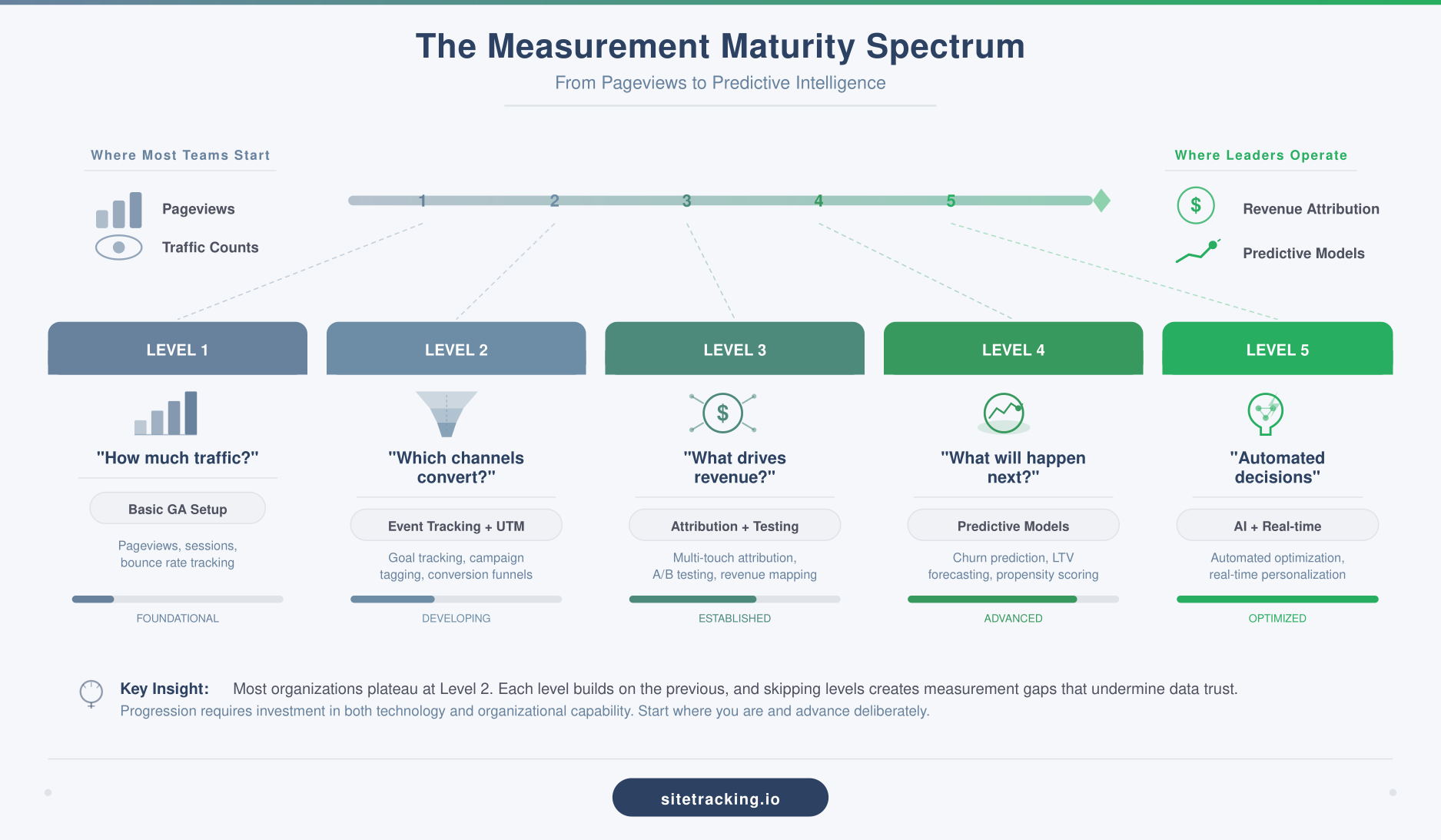
The five levels of measurement maturity
Measurement maturity isn’t binary. It’s a spectrum with distinct stages, each building on the last. Here’s how to identify where your organization currently sits.
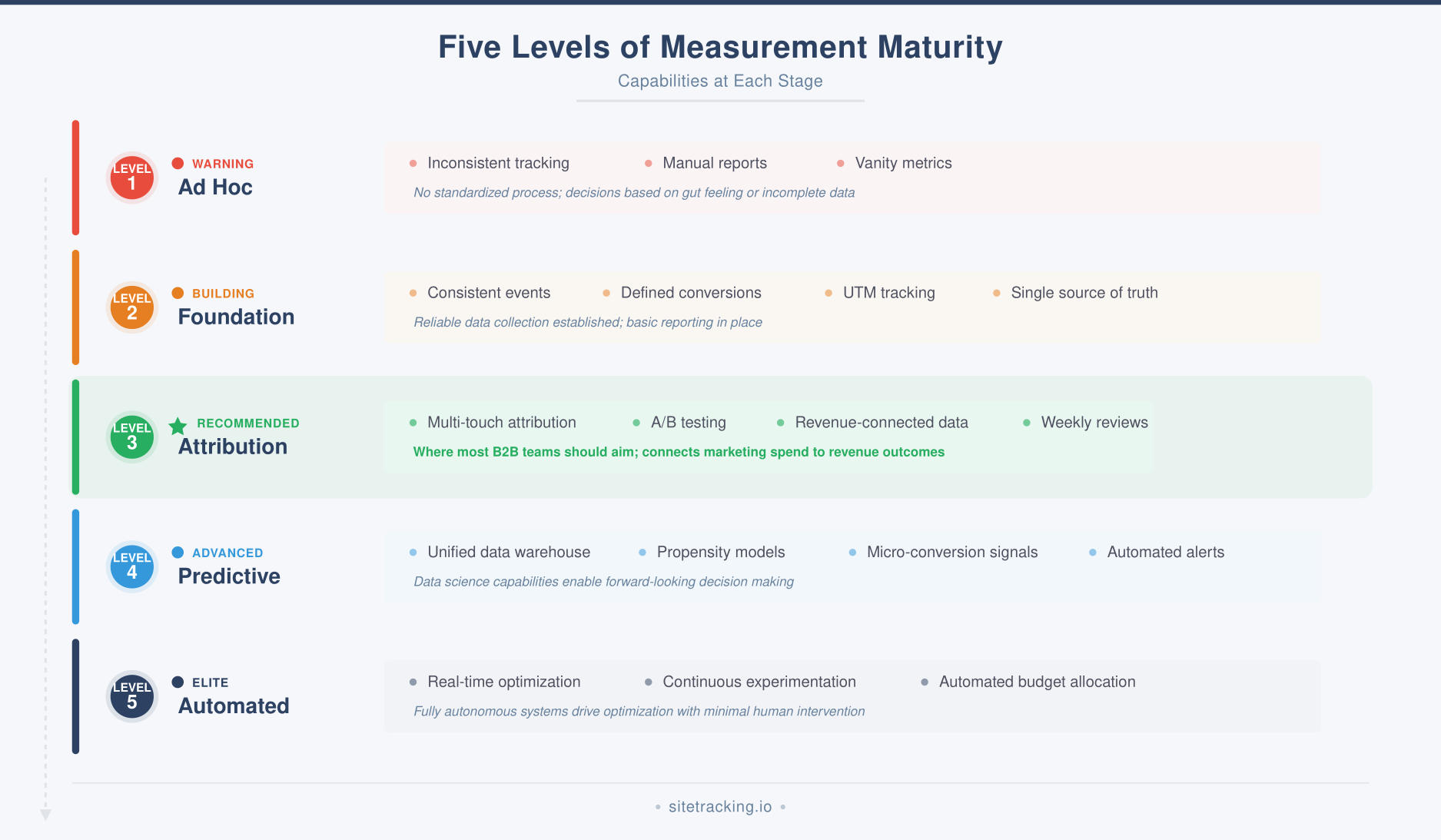
Level 1: Ad hoc tracking
At this level, analytics exists but it’s inconsistent and unreliable. Google Analytics is installed but nobody’s sure if it’s configured correctly. Marketing reports are pulled manually from different platforms, and the numbers rarely agree. Teams report on vanity metrics like total pageviews or social followers because meaningful metrics aren’t available.
Signs you’re at Level 1: No consistent event naming conventions, different teams report different numbers for the same metric, and nobody can explain how “conversions” are defined.
Level 2: Foundational measurement
Analytics is properly configured with consistent tracking across your website. You have defined conversion events that everyone agrees on. Basic campaign tracking with UTM parameters is in place. Reports are standardized, and there’s a single source of truth for core metrics.
Signs you’re at Level 2: You can answer “how much traffic did we get last month?” and “which channels drove the most conversions?” with confidence, but you struggle to connect those conversions to revenue or measure cross-channel impact.
Level 3: Attribution and optimization
You’ve moved beyond last-click attribution to multi-touch models. You understand how channels work together, not just individually. You’re running A/B tests on landing pages and ad creative. Conversion tracking is tied to actual revenue data, not just form submissions. Marketing dashboards are used weekly for decision making.
Signs you’re at Level 3: You can explain which attribution model you use and why. You have a testing roadmap. Marketing and sales share a common definition of a qualified lead. But you’re still reactive — you optimize based on what happened, not what’s predicted to happen.
Level 4: Predictive analytics
Data from multiple sources is integrated into a unified view. You’re using micro-conversions to predict revenue, building propensity models, and forecasting campaign performance before spending budget. Customer lifetime value informs acquisition strategy. You’ve moved from “what happened” to “what will happen.”
Signs you’re at Level 4: You can predict which leads will convert before they do. Your budget allocation is model-driven, not gut-driven. You have automated alerts for anomalies. But insights still require analyst interpretation — they’re not fully embedded in marketing workflows.
Level 5: Automated intelligence
Measurement is fully integrated into decision-making workflows. Predictive models automatically adjust bidding, budgets, and targeting. Anomaly detection triggers alerts and suggested actions without human intervention. Marketing and finance share real-time revenue attribution. The measurement system doesn’t just inform decisions — it makes many of them automatically.
Signs you’re at Level 5: Marketing experiments run continuously with automated analysis. Budget reallocation happens weekly based on model outputs. You can calculate the marginal return of the next dollar spent in any channel. Very few organizations reach this level — it requires significant data infrastructure and organizational alignment.
How to assess your current level
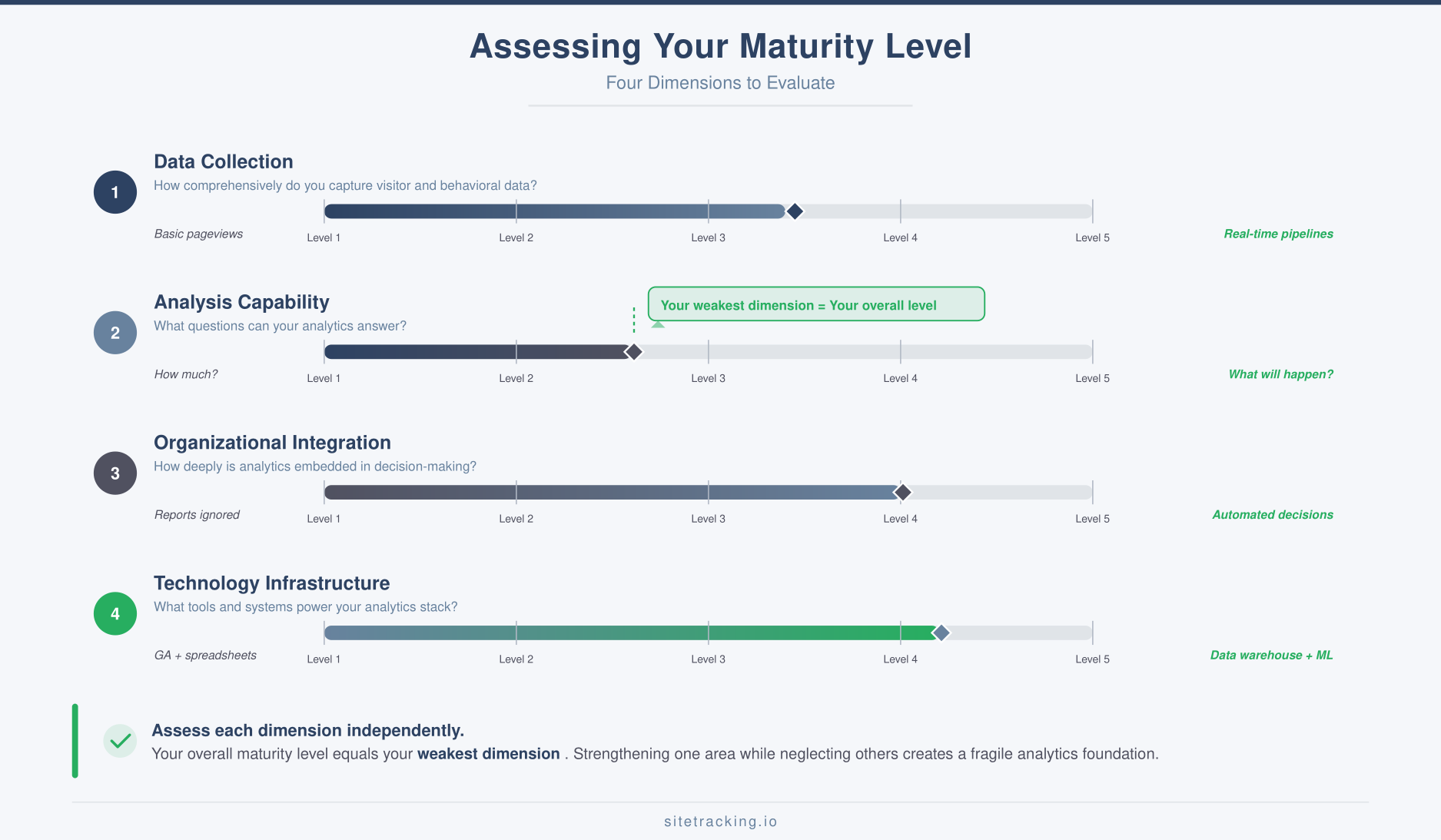
Use these four dimensions to evaluate where you stand. Your overall maturity level is typically determined by your weakest dimension — a chain is only as strong as its weakest link.
Data collection
How comprehensive and accurate is your tracking? At Level 1, you have basic pageview tracking. At Level 3, you have event-level tracking with consistent naming, cross-domain measurement, and server-side validation. At Level 5, you have real-time data pipelines feeding unified customer profiles across all touchpoints.
Analysis capability
What questions can you answer with your data? Level 1 answers “how much?” Level 3 answers “why?” and “what should we change?” Level 5 answers “what will happen if we change X?” and automatically acts on the answer.
Organizational integration
How deeply is data embedded in decision-making? At Level 1, reports exist but nobody reads them. At Level 3, marketing leadership reviews dashboards weekly and adjusts strategy. At Level 5, data drives decisions at every level — from individual campaign management to board-level budget allocation.
Technology and infrastructure
What tools and systems support your measurement? Level 1 has Google Analytics and spreadsheets. Level 3 has a tag management system, a BI tool, and integrated CRM data. Level 5 has a data warehouse, automated ETL pipelines, machine learning models, and real-time dashboards accessible across the organization.
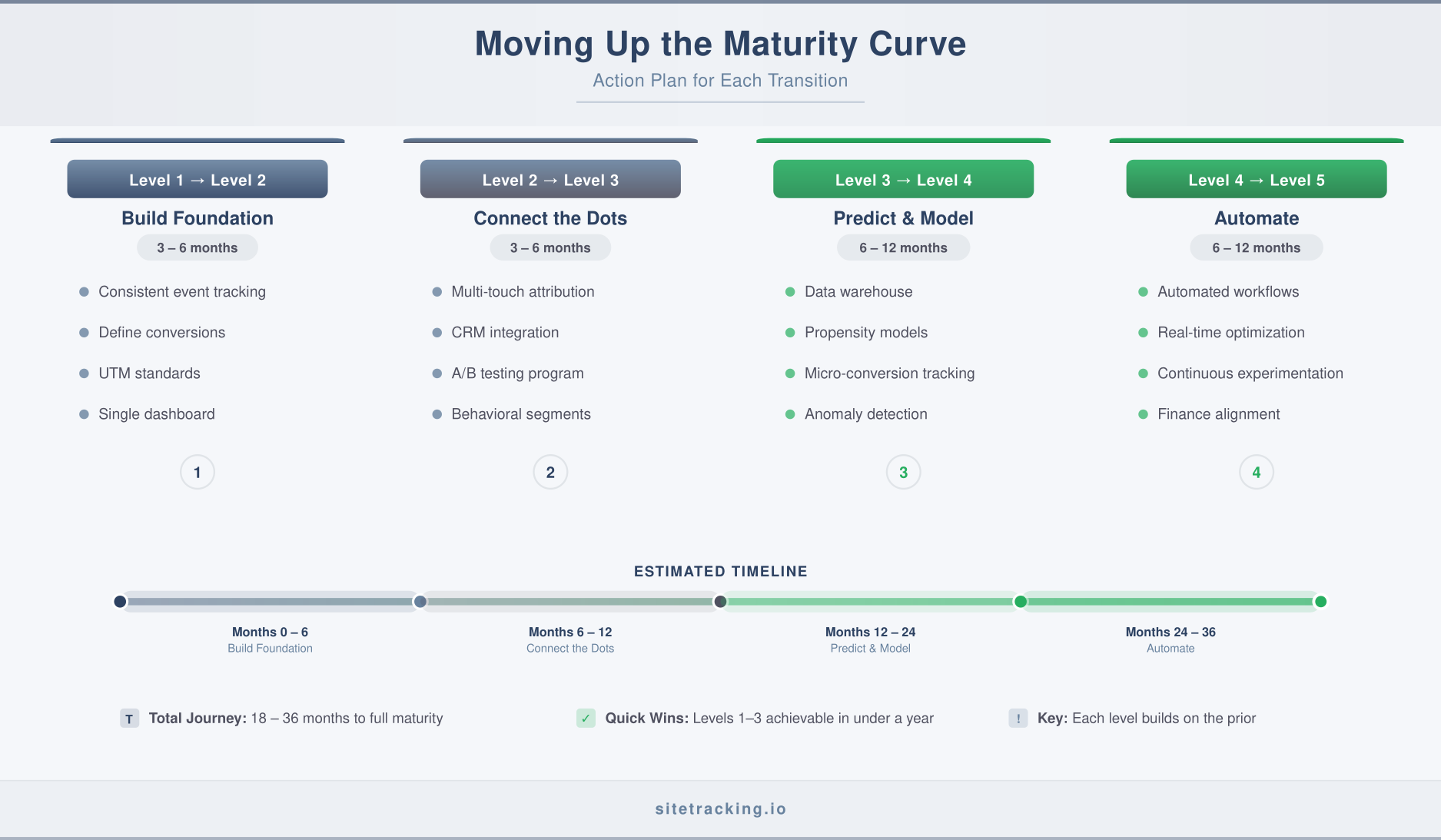
Moving up the maturity curve
Jumping from Level 1 to Level 5 isn’t realistic. Each level builds capabilities that the next level depends on. Here’s what to focus on at each transition.
Level 1 to Level 2: Build the foundation
- Implement consistent event tracking with standardized naming conventions
- Define and document what counts as a conversion for your business
- Set up UTM parameter standards for all campaigns
- Create a single reporting dashboard that all teams reference
- Assign ownership — someone must be responsible for data quality
Level 2 to Level 3: Connect the dots
- Implement multi-touch attribution and understand its limitations
- Connect marketing data to revenue data (CRM integration)
- Start a structured A/B testing program
- Build audience segments based on behavior, not just demographics
- Establish a regular cadence for data-driven optimization reviews
Level 3 to Level 4: Predict and model
- Implement a data warehouse to unify data from all sources
- Build propensity and lifetime value models
- Track and value micro-conversions as predictive signals
- Automate anomaly detection and alerting
- Hire or develop data science capability within the marketing team
Level 4 to Level 5: Automate and integrate
- Embed predictive models into automated decision workflows
- Implement real-time budget optimization across channels
- Build continuous experimentation infrastructure
- Align marketing measurement with finance reporting
- Create a measurement center of excellence that serves the entire organization
Common mistakes in the maturity journey
- Buying Level 5 tools at Level 1 maturity. A $50,000 BI platform doesn’t help if your underlying data is inconsistent. Fix data quality before investing in advanced tools.
- Skipping levels. Each level builds capabilities the next depends on. You can’t do meaningful attribution (Level 3) without reliable conversion tracking (Level 2).
- Focusing on tools over process. Measurement maturity is as much about organizational habits as technology. Weekly data reviews, documented definitions, and cross-team alignment matter as much as which analytics platform you use.
- No executive sponsorship. Moving beyond Level 2 requires organizational change, and that requires leadership support. Without it, measurement improvements stall at the individual contributor level.
- Perfectionism. Don’t wait for perfect data before making decisions. Level 2 data is good enough to start optimizing. You can improve data quality iteratively while still extracting value from what you have.
Frequently Asked Questions
What level should we aim for?
Level 3 is the sweet spot for most organizations. It provides multi-touch attribution, testing capability, and revenue-connected measurement — enough to make genuinely data-driven decisions. Levels 4-5 require significant investment and are most valuable for large organizations with complex marketing operations and big budgets to allocate.
How long does it take to move up one level?
Typically 3-6 months per level, depending on resources and organizational complexity. Level 1 to 2 is the fastest because it’s mainly technical implementation. Level 3 to 4 is the slowest because it requires new skills (data science) and infrastructure (data warehouse).
Can different teams be at different maturity levels?
Yes, and this is common. Your paid media team might be at Level 3 (with good attribution and testing) while your content team is at Level 1 (tracking pageviews only). The goal is to bring all teams to at least Level 2 before pushing any team to Level 4+, because cross-team data consistency is critical for higher-level capabilities.
Key takeaways
- Measurement maturity is a spectrum with five distinct levels, from ad hoc tracking to automated intelligence.
- Assess across four dimensions: data collection, analysis capability, organizational integration, and technology infrastructure.
- Level 3 is the target for most organizations — it provides attribution, testing, and revenue-connected measurement.
- Don’t skip levels — each one builds capabilities the next depends on. Fix foundations before investing in advanced tools.
- Process matters as much as tools — weekly reviews, documented definitions, and executive sponsorship drive maturity as much as technology.
- Plan for 3-6 months per level and focus investment on your weakest dimension first.
A measurement maturity model isn’t just a diagnostic exercise — it’s a strategic roadmap. Knowing where you are tells you exactly what to build next, in what order, and what to skip for now. The organizations that win at marketing aren’t the ones with the most data — they’re the ones who’ve built the capabilities to actually use it. Start by honestly assessing your current level, identify the specific gaps holding you back, and invest in the next level’s requirements. The compound effect of each level’s improvement builds on the last, creating a measurement practice that becomes a genuine competitive advantage.