
What Is a Micro Conversion? Definition, Examples, and How to Pick Yours
You’re staring at a funnel report. Two thousand people landed on the pricing page last month, eleven bought. The other 1,989 did something — but your analytics has no opinion about what.
That gap is where micro conversions live. They’re the small, deliberate actions a visitor takes on the way to a purchase, and most tracking setups either ignore them or drown in them.
This piece covers what counts as one, what doesn’t, and how to pick the handful worth tracking on your own site.
What is a micro conversion?
A micro conversion is a completed action that signals intent but doesn’t produce revenue by itself. It moves someone closer to the outcome you actually care about.
The macro conversion is the one that pays: a purchase, a signed contract, a qualified demo booked. Everything measurable that reliably precedes it is a candidate micro conversion.
The word “deliberate” is doing real work in that definition. A visitor scrolling past your pricing table did not decide anything. A visitor who expanded the comparison table, switched the billing toggle to annual, and then opened the FAQ made three small decisions in a row.
What separates a micro conversion from ordinary engagement?
This is where most tracking plans go wrong. Teams tag everything clickable, call it all a conversion, and end up with a dashboard that moves whether or not the business does.
Three tests separate the two. An action qualifies only if it passes all three:
- It required a decision. The visitor chose to do it. Time on page and scroll depth fail here — they happen whether or not anyone is paying attention.
- It correlates with the outcome. People who do it convert at a measurably higher rate than people who don’t. If the rates match, you’ve found a habit, not a signal.
- You can act on it. Knowing the number changes something you would do — a retargeting audience, a page fix, a follow-up sequence. Otherwise it’s decoration.
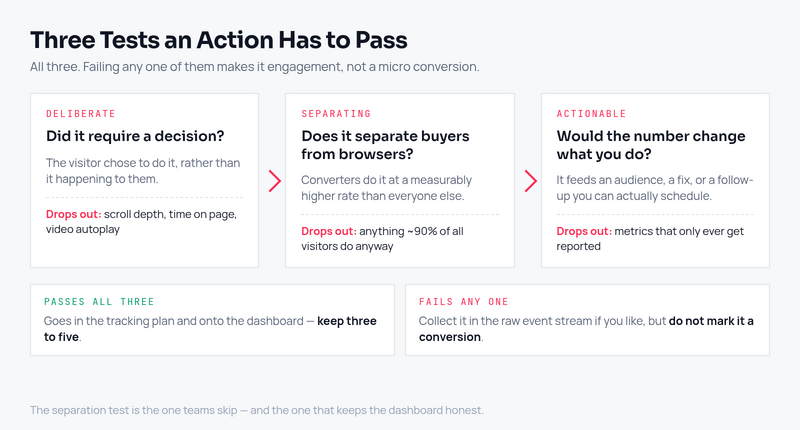
Test two is the one people skip, and it’s the one that saves you. Run it before you commit a new event to the tracking plan, not after six months of collecting it.
Micro conversion examples by business model
The same action means different things in different funnels. A newsletter signup is a strong signal for a content business and near-noise for enterprise software with a nine-month sales cycle.
| Business model | Macro conversion | Micro conversions worth tracking |
|---|---|---|
| Ecommerce | Completed order | Add to cart · size or variant selected · wishlist save · shipping calculator used · review section opened |
| SaaS, self-serve | Paid subscription | Trial started · billing toggle switched to annual · pricing comparison expanded · docs search performed · second session within 7 days |
| B2B, sales-led | Qualified opportunity | Case study downloaded · pricing page visited twice · calculator completed · job title entered on a gated form |
| Lead generation | Booked appointment | Phone number revealed · directions requested · availability checked · quote form started |
| Publisher | Subscription or ad revenue target | Newsletter signup · second article opened in one session · comment posted · paywall preview dismissed |
Notice how few of these are clicks on things. Most are moments where the visitor supplied information or narrowed a choice, which is exactly what makes them predictive.
How do you find yours instead of copying a list?
Borrowed lists are a starting point, not an answer. The actions that predict revenue on your site depend on your pricing, your funnel length, and how much research your buyer does before committing.
The method is the same regardless of platform, and you can run it with data you already collect:
- List the candidates first, on paper. Walk your own funnel and write down every deliberate action available to a visitor. Ten to fifteen is normal.
- Split converters from non-converters. Take a completed month and compare the two groups on each candidate action.
- Compute the lift, not the raw count. The question is what share of converters did the action versus what share of everyone else. A candidate that 90% of converters performed is useless if 88% of non-converters performed it too.
- Keep three to five. Past that, nobody reads the dashboard and every number gets weaker attention.
- Re-test after any funnel change. Redesign the pricing page and the signal that used to predict revenue may stop predicting anything.
In my experience the surprising ones survive and the obvious ones die. Add-to-cart is on every list ever published, but on sites with heavy cart abandonment it barely separates buyers from browsers. Meanwhile something unglamorous — checking delivery times, opening the returns policy — turns out to split the groups cleanly.
Once you have the shortlist, the arithmetic for tracking performance over time is covered in how to calculate micro conversion rate.
A worked example: separating signal from habit
Numbers make the lift test concrete. Take a month with 40,000 sessions and 600 orders — a 1.5% conversion rate, which is unremarkable for a mid-size store.
Five candidate actions were on the tracking plan. For each one, compare how often converters did it against how often everyone else did.
| Candidate action | Share of buyers | Share of non-buyers | Gap | Verdict |
|---|---|---|---|---|
| Opened the returns policy | 34% | 6% | +28 pts | Strong signal |
| Used the delivery estimator | 52% | 19% | +33 pts | Strong signal |
| Added to cart | 96% | 71% | +25 pts | Useful, but late |
| Scrolled past 75% | 88% | 84% | +4 pts | Habit, not signal |
| Viewed 3+ product pages | 61% | 57% | +4 pts | Habit, not signal |
Two of the five carry information. Two are things almost everybody does, buyers and browsers alike, so knowing the number tells you nothing about who is close to purchasing.
Add-to-cart is the interesting case. The gap is real, but it sits so late in the funnel that by the time it fires you have already won most of the argument. It earns a place in reporting and a poor place in a retargeting audience, because the people it identifies were about to buy anyway.
The delivery estimator is the opposite. It fires early, it splits the groups cleanly, and it points at a fixable objection — which means the number connects to work you can schedule.
One caution on reading a table like this. Correlation here is a filter, not proof of cause. Nobody buys because they read a returns policy; the reading and the buying share an underlying seriousness. That is fine for picking signals and dangerous if you conclude that forcing more people onto the returns page will lift sales.
Where do micro conversions earn their keep?
Tracking them is not the point. Four uses justify the work, and if none apply, skip the event.
| Use | What changes |
|---|---|
| Diagnosing the funnel | You see which step loses people, instead of only knowing the total is down |
| Building audiences | Retargeting reaches people who showed intent rather than everyone who loaded a page |
| Feeding ad platforms | Low-volume accounts give the bidding algorithm enough signal to optimise against |
| Testing faster | An experiment reaches significance on a mid-funnel action long before it would on purchases |
The third use deserves a warning. Optimising an ad campaign toward a micro conversion works when the signal genuinely predicts revenue, and quietly wastes budget when it doesn’t — the platform will happily find you thousands of people who add to cart and never buy.
Which micro conversions carry real revenue weight is a separate question, and one worth answering before you hand any of them to a bidding algorithm. Micro-conversions that predict revenue goes through that analysis.
Where does each one sit in the funnel?
Two signals can both be genuine and still do completely different jobs, because they fire at different distances from the sale. Sorting your shortlist by stage stops you from stacking all of them at the bottom.
- Early — the visitor is orienting. Comparison table expanded, docs search performed, calculator opened. Volume is high, precision is low, and these are what you use to build audiences worth retargeting.
- Middle — the visitor is evaluating. Delivery estimated, returns policy read, annual billing selected. This is the richest band: enough volume to test against, enough intent to mean something.
- Late — the visitor is committing. Added to cart, checkout started, form half-completed. High precision, low volume, and mostly useful for diagnosing where a nearly-finished purchase falls apart.
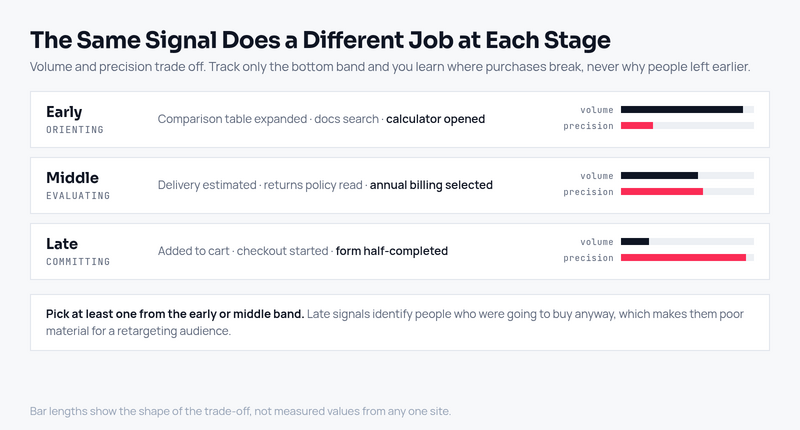
Aim for at least one signal from the early or middle band. Teams that track only late-stage actions can tell you the checkout is leaking and never why anyone left before reaching it.
What to capture when the event fires
Picking the right actions is half the work. The other half is deciding what each event carries with it, and this is where a tracking plan quietly limits what you can ask six months from now.
An event with no parameters can answer one question: how many times did this happen. Add two or three well-chosen properties and the same event answers a dozen.
| Capture | Why | Question it answers later |
|---|---|---|
| Where it happened page type, not full URL | URLs change; page roles don’t | Does this signal work on category pages as well as product pages? |
| What it was about the object — plan, category, variant | Ties the action to the thing being considered | Which plan do people compare before they abandon? |
| Which attempt this is first time or repeat in the session | Distinguishes one interested person from four events | Does repeating the action raise the odds, or flatten them? |
| How it was triggered click, auto, keyboard | Separates deliberate acts from side effects | Is this event contaminated by something firing on its own? |
Resist the urge to attach everything available. Each parameter is a thing that can drift, get renamed, or arrive empty on half your traffic, and a plan nobody maintains rots faster than one that stayed small.
One rule saves the most trouble: record the raw fact, not your interpretation of it. Store which billing period was selected, not a flag called high_intent. Interpretations change when the business changes; the underlying fact stays comparable across the whole history.
What goes wrong with micro conversion tracking?
Four failures account for most of the mess I find during audits.
- Everything marked as a conversion. When fifteen events all carry conversion status, the reports stop distinguishing between someone who bought and someone who scrolled.
- Counting the same intent twice. A visitor who opens the pricing FAQ four times is one interested person, not four. Decide up front whether you count events or people.
- Naming drift. Six months in you have
add_to_cart,addToCartandcart-addfrom three different implementations. Naming conventions are boring right up until they cost you a quarter of history. - Reporting the count without the rate. Micro conversions rose 40% — so did sessions. The absolute number tells you almost nothing on its own.
The naming problem is the expensive one, because it’s the only failure on the list you cannot fix retroactively. Our event naming conventions guide covers the structure that prevents it.
Frequently asked questions
Is a newsletter signup a micro conversion or a macro one?
It depends on what pays your bills. For a publisher selling subscriptions or ad inventory, the signup is close to the revenue event and behaves like a macro conversion. For an ecommerce store it sits mid-funnel, and its value is whatever share of subscribers eventually order.
How many should I track?
Three to five. The constraint is attention rather than storage — a dashboard nobody reads has the same value as no dashboard. Track more in the raw event stream if you like, but promote only a handful to reporting.
Should I assign monetary values to them?
Only if you can defend the number. A defensible value is the conversion rate from that action to a sale, multiplied by average order value. Numbers invented to make a dashboard look complete will eventually be used in a budget decision, which is how they cause damage.
Do micro conversions work for long B2B sales cycles?
They matter more there, not less. When the macro conversion arrives nine months after the first visit, mid-funnel signals are the only feedback you get inside a quarter. Just expect the correlation to be looser and re-test it more often.
What’s the difference between a micro conversion and an engagement metric?
A micro conversion required a decision and predicts revenue. An engagement metric describes behaviour without either property. Session duration is engagement; choosing annual billing is a micro conversion.
Where to start on your own site
Open your funnel, list every deliberate action a visitor can take, and pick the three you’d bet on. Then check them against last month’s converters before you write a single tag.
Most teams discover that one of their three is worthless and one they nearly discarded is the strongest predictor they have. That result is worth an afternoon, and it costs nothing but a query.